Environmental regulation, sustainability standards, and fisheries.
 ▶
2025-02
Marcelo Dolabella finds that greater sustainability certification is associated with agricultural export growth, but benefits vary with products, destinations, and market saturation. Emilia Lamonaca and audience questions expose important limits concerning measurement, causality, and whether consumers or corporate buyers drive the relationship.
Read brief & watch → ▶
2024-07
Michael Gasiorek uses EV trade patterns to question US and EU tariff rationales. Discussion examines preemptive protection, supply-chain adjustment and competing industrial and climate objectives. Audience questions expose data limits, while the closing exchange emphasizes consumer and environmental counterfactuals.
Read brief & watch → ▶
2024-04
Emilia Lamonaca presents work on environmental technical measures, domestic emissions and trade. Amrita Saha asks how production, consumption and development change the interpretation. Q&A makes aggregation, uneven notifications and embodied emissions central to evaluating the conclusions.
Read brief & watch → ▶
2024-02
Christine McDaniel and Sarah Stewart explain why a fisheries subsidies agreement cannot deliver sustainable fishing on its own. Their exchange connects ecological information, local monitoring, legal disciplines, and negotiating realities—and identifies access agreements and implementation evidence as research priorities.
Read brief & watch →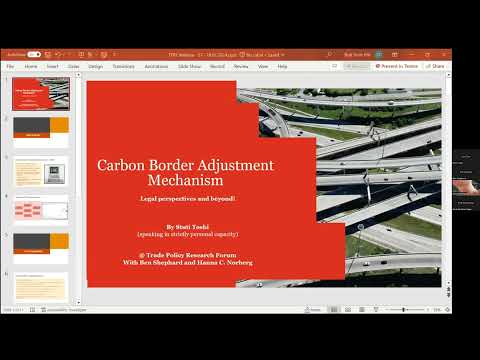 ▶
2024-01
The session examines CBAM as a response to unequal carbon prices, with contested legal and distributional implications. Economic effects depend on adjustment across sectors and markets; emissions-price volatility creates a separate uncertainty channel.
Read brief & watch → ▶
2023-12
Fabio Santeramo examines how environmental technical measures affect trade, emphasizing variation across countries and products. Ben Shepherd’s discussion turns the policy question toward welfare, imperfect notification data, and firm-level responses—issues that cannot be resolved simply by counting regulations or estimating average trade effects.
Read brief & watch → ▶
2023-05
Fisheries-subsidy reform depends on stock management, information and negotiating capacity. A risk framework guides action without claiming every subsidy's ecological effect is identified. Discussion asks how stronger disciplines, assistance and better measurement can jointly support sustainability and developing-country interests.
Read brief & watch → ▶
2022-12
Isabela Manelici finds that responsible-sourcing requirements improve pay for targeted workers while creating costs elsewhere in Costa Rica’s economy. Sara Schoenfeld’s questions turn the analysis toward who finances compliance, supplier support, and what ethical claims can establish.
Read brief & watch →