A short way into each conversation: three takeaways, the discussion that qualified them, and timestamped links to the recording.
 ▶
2026-09
Speakers from OECD, Global Trade Alert and UN Trade and Development describe AI-assisted research, regulatory data collection and access to evidence. Their message is to formalize tasks, sources and expert verification. Q&A exposes confidentiality and source-coverage limits that a better model alone cannot resolve.
Read brief & watch → ▶
2026-04
Ahmad Lashkaripour demonstrates a fast tariff-war model and public dashboard, then discusses what their results depend on: strategic retaliation, elasticities, welfare definitions, and production structure. The conversation makes clear why an accessible interface still needs careful economic interpretation.
Read brief & watch → ▶
2025-07
Ugandan procurement raises suppliers’ sales but crowds out their private business without clear evidence of lasting capacity expansion. Filippo Santi and Anirudh Shingal distinguish commercial gains for contractors from the broader development and trade objectives governments hope procurement will deliver.
Read brief & watch → ▶
2025-06
Pol Antràs maps research gaps in trade, from oligopoly and global value chains to national security and measurement. Sébastien Dessus translates the agenda into development-policy needs. Their exchange calls for institutions, distribution and industry detail alongside numerical model outputs.
Read brief & watch → ▶
2025-05
Saon Ray examines India’s imports from ASEAN as a route into regional production networks. Thi Thanh Ha Doan’s discussion sharpens the distinction between an aggregate import relationship and evidence about value chains, while the Q&A considers integration, policy uncertainty, and India’s absence from RCEP.
Read brief & watch → ▶
2025-04
Henry Gao and Huan Zhu examine the April 2025 tariff confrontation as a negotiation over economic rules and political priorities. Their discussion contrasts an ambitious interpretation of US strategy with uncertainty about credible concessions, while identifying Chinese domestic reform as a possible route toward a less confrontational outcome.
Read brief & watch → ▶
2025-03
Amita Batra argues that India’s merchandise-trade strategy has not sufficiently adapted to cross-border production. Amrita Saha adds domestic political economy and unequal regional exposure. The discussion links inputs, investment and agreement depth to employment, upgrading and livelihood concerns.
Read brief & watch → ▶
2025-02
Marcelo Dolabella finds that greater sustainability certification is associated with agricultural export growth, but benefits vary with products, destinations, and market saturation. Emilia Lamonaca and audience questions expose important limits concerning measurement, causality, and whether consumers or corporate buyers drive the relationship.
Read brief & watch → ▶
2025-01
Emmanuel Orkoh examines whether online presence can broaden firms’ participation in exports. Johanna Hill connects the evidence to digital infrastructure, skills, regulation, and WTO cooperation. Their exchange distinguishes helping disadvantaged firms trade from ensuring those firms catch up with stronger competitors.
Read brief & watch → ▶
2024-11
In November 2024, Mary Lovely and Michael Ferrantino examine the prospective US tariff agenda through input costs, tax policy, investment and retaliation. Audience questions draw out origin rules, supply-chain research and the difficulty of dividing the world into stable blocs.
Read brief & watch → ▶
2024-10
Independent trade-policy work takes several forms: solo practice, a consulting firm, or a specialist team within a university. The panel explains how to find first assignments, become visible through substantive work, and choose a business model that fits the work one actually wants to do.
Read brief & watch → ▶
2024-09
The Iron Curtain sharply restricted trade, but its permeability changed over time. Benedikt Heid and Costanza Bosone use the historical evidence to question simple bloc narratives—and explain why modest aggregate welfare estimates should not be mistaken for harmless fragmentation.
Read brief & watch → ▶
2024-07
Michael Gasiorek uses EV trade patterns to question US and EU tariff rationales. Discussion examines preemptive protection, supply-chain adjustment and competing industrial and climate objectives. Audience questions expose data limits, while the closing exchange emphasizes consumer and environmental counterfactuals.
Read brief & watch → ▶
2024-06
Ben Shepherd tests whether a quantitative trade model’s tariff counterfactuals help explain observed trade changes. Hildegunn Nordås welcomes the accessible validation exercise but presses on model assumptions, bilateral omitted factors, adjustment timing, and how performance might change during structural upheaval.
Read brief & watch → ▶
2024-05
Bob Koopman and Michael Ferrantino explain how to brief policymakers without burying the answer or compromising the analysis. Their examples cover concise recommendations, intelligible uncertainty, political constraints, and misunderstandings when economists, lawyers, and advocates share a room.
Read brief & watch → ▶
2024-04
Emilia Lamonaca presents work on environmental technical measures, domestic emissions and trade. Amrita Saha asks how production, consumption and development change the interpretation. Q&A makes aggregation, uneven notifications and embodied emissions central to evaluating the conclusions.
Read brief & watch → ▶
2024-03
Arne Nagengast shows that allowing agreement effects to vary across cohorts and time substantially changes gravity estimates. Rebecca Freeman and the Q&A explore slow adjustment, agreement content and causal limits, cautioning against treating weak recent-cohort estimates as proof that new agreements are ineffective.
Read brief & watch → ▶
2024-02
Christine McDaniel and Sarah Stewart explain why a fisheries subsidies agreement cannot deliver sustainable fishing on its own. Their exchange connects ecological information, local monitoring, legal disciplines, and negotiating realities—and identifies access agreements and implementation evidence as research priorities.
Read brief & watch →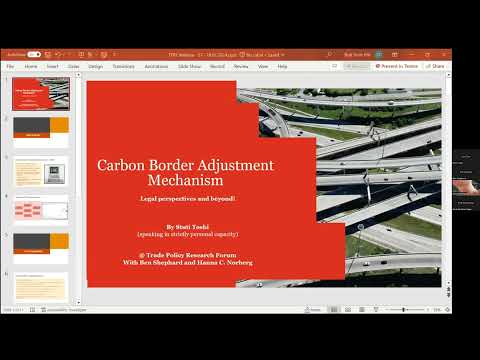 ▶
2024-01
The session examines CBAM as a response to unequal carbon prices, with contested legal and distributional implications. Economic effects depend on adjustment across sectors and markets; emissions-price volatility creates a separate uncertainty channel.
Read brief & watch → ▶
2023-12
Fabio Santeramo examines how environmental technical measures affect trade, emphasizing variation across countries and products. Ben Shepherd’s discussion turns the policy question toward welfare, imperfect notification data, and firm-level responses—issues that cannot be resolved simply by counting regulations or estimating average trade effects.
Read brief & watch → ▶
2023-10
Patrik Tingvall and Simon Evenett examine the return of strategic intervention through the design and international effects of subsidies. They challenge automatic policy imitation, distinguish legitimate objectives from appropriate instruments, and make transparency and evaluation the central practical response.
Read brief & watch → ▶
2023-09
Five practitioners describe nonlinear routes into trade policy. Their advice combines technical training, field exposure, communication and experimentation. Country experience reveals implementation constraints that headquarters work can miss; recruitment values different combinations of skills depending on the actual role.
Read brief & watch → ▶
2023-07
Hildegunn Nordås shows how draft treaty provisions can be translated into services-policy counterfactuals. The discussion with Amrita Saha moves beyond export gains to measurement limits, domestic regulation, and the development evidence needed to make an agreement politically persuasive.
Read brief & watch → ▶
2023-06
Douglas Zeng and Cholachit Vorawangso Virakul discuss when special economic zones and economic corridors can support development. Research and Thailand’s experience converge on investor demand, functioning services, skills, and connections to existing production—not simply a designated area and tax concessions.
Read brief & watch → ▶
2023-05
Fisheries-subsidy reform depends on stock management, information and negotiating capacity. A risk framework guides action without claiming every subsidy's ecological effect is identified. Discussion asks how stronger disciplines, assistance and better measurement can jointly support sustainability and developing-country interests.
Read brief & watch → ▶
2023-04
Emily Benson and Dan Ciuriak distinguish supply-chain risk management from politically driven friend-shoring. Moderated by Mia Mikic, the conversation examines what governments would need to specify, how firms could respond, and why third-country development and longer-run strategic consequences belong in the assessment.
Read brief & watch → ▶
2023-03
Dan Trefler and Javier López González examine AI as both a driver and a beneficiary of trade. Mobile-app research supplies concrete evidence, while discussion moves to measurement, privacy, standards, and organizational constraints on technological change.
Read brief & watch → ▶
2023-02
Marina Ngoma finds positive manufacturing-employment effects from Chinese import exposure in Ethiopia, principally through input access. Paul Brenton contextualizes these gains within restrictive foreign-exchange allocation and weak industrial transformation. Discussion qualifies causal identification and extrapolation beyond observed formal-sector industries.
Read brief & watch → ▶
2023-01
Thi Thanh Ha Doan uses Chinese firm data to examine how technical requirements reshape exports. Some firms exit, while surviving exporters show higher sales and estimated quality. Mahdi Ghodsi’s discussion highlights how measurement, selection, and the treatment of resolved trade concerns affect interpretation.
Read brief & watch → ▶
2022-12
Isabela Manelici finds that responsible-sourcing requirements improve pay for targeted workers while creating costs elsewhere in Costa Rica’s economy. Sara Schoenfeld’s questions turn the analysis toward who finances compliance, supplier support, and what ethical claims can establish.
Read brief & watch → ▶
2022-11
Randomized US survey experiments show that accessible research findings need not move trade preferences in the expected direction. Price-benefit messages can increase protectionist preferences. Discussion separates these experimental results from promising but untested approaches involving locally relevant information, adjustment assistance and participation.
Read brief & watch → ▶
2022-10
Ben Shepherd models how better border procedures change sourcing and value-chain participation. Maria Persson’s discussion focuses on what the aggregate exercise cannot yet tell practitioners: fixed versus variable costs, differences between shipments, and which reform should come first when resources are scarce.
Read brief & watch → ▶
2022-09
Vicky Chemutai, Greg Messenger, and Michael Ferrantino describe different routes into trade-policy work. Their advice emphasizes credible skills, thoughtful outreach, and communication, while their discussion of doctoral training acknowledges institutional constraints and personal tradeoffs.
Read brief & watch → ▶
2022-07
Trade eventually expanded pandemic medical-goods access, but early shortages exposed concentrated supply without sufficient inventories or visibility. The session emphasizes detailed product data, upstream bottlenecks and coordinated investment, while distinguishing observed responses from unidentified effects of particular policies.
Read brief & watch → ▶
2022-05
Erdal Yalcin, Zongyuan Zoe Liu, and Maksym Chepeliev connect historical sanctions evidence, payment-system constraints, and energy-embargo modeling. Michael Ferrantino’s questions sharpen three distinctions: economic damage versus political success, financial messaging versus settlement, and hypothetical scenarios versus measures actually under discussion.
Read brief & watch → ▶
2022-04
Dennis Novy shows why a common trade-cost change can produce very different percentage trade responses across partners. Translog gravity makes the response depend on initial import shares. Yuan Zi probes whether this reflects heterogeneous elasticities, heterogeneous policy shocks, or model assumptions—and what follows for welfare.
Read brief & watch → ▶
2022-03
Korea's heavy-industry drive and a review of US policy episodes illustrate why industrial-policy assessment needs long horizons, explicit objectives and competition. Discussion separates persistent firm growth from modeled welfare and asks how far historical success can guide policy elsewhere.
Read brief & watch → ▶
2022-02
Stephen Adams and Maura Décosterd explain how firms and investors assess trade-policy risk within real supply chains. The discussion moves from tariffs to origin, sanctions, reporting, and political uncertainty, highlighting the difference between understanding today’s rules and making defensible judgments about tomorrow’s exposure.
Read brief & watch → ▶
2022-01
Ben Shepherd connects a policy question, structural gravity specification, estimation, and counterfactual simulation. An estimated bilateral coefficient is not a complete policy impact. Discussion with Silvia Sorescu examines domestic shipments, global value chains, missing data, and the limits of mechanical extensions.
Read brief & watch → ▶
2021-12
3D printing can expand trade through better production rather than simply replace shipped goods with digital files. Research and practical experience highlight customization, skills and technical limits. Discussion emphasizes imperfect adoption measures, regulatory obstacles and whole-chain environmental assessment.
Read brief & watch → ▶
2021-11
Amrita Bahri and José-Antonio Monteiro examine how trade agreements address gender inequality and why provisions may fail to become practice. Their discussion distinguishes market access from the capacity to use it, and treaty innovation from evidence that commitments improve women’s economic lives.
Read brief & watch → ▶
2021-10
Maurizio Zanardi explains antidumping's administrative discretion and political economy. Veysel Avsar presents Turkish evidence that targeted exporters respond by offering more trade credit. Their discussion connects payment terms, downstream input users, and global value chains, while explicitly recognizing limits to the study's causal identification.
Read brief & watch → ▶
2021-09
Digital-policy mapping improves transparency but does not itself establish economic or social effects. Ferracane and Fritz explain complementary databases, the difference between regulation and integration, and the importance of assessing privacy and security alongside business costs. Discussion considers interoperability and developing-country participation.
Read brief & watch → ▶
2021-07
Syed Uddin presents evidence linking immigrant networks to US exports across products, skill categories, and trade margins. Philippe Legrain broadens the discussion to entrepreneurship and diversity, while Ben Shepherd asks whether networks serve neighboring markets and whether information is the mechanism behind the estimates.
Read brief & watch → ▶
2021-06
Lucian Cernat proposes letting preferences follow LDC inputs through third-country processing. Model simulations suggest additional exports and supply-chain integration. Marion Jansen tests the proposal's productivity assumptions, upgrading incentives, and implementation burden; the discussion also raises the unresolved distribution of tariff savings between LDC suppliers and downstream buyers.
Read brief & watch → ▶
2021-05
Blockchain's potential in trade depends on legal recognition, shared standards, governance and integration with other technologies. The speakers distinguish operating projects from broader ambitions. Q&A highlights substantial adoption costs, limited cross-border scaling and the absence of reliable measures of blockchain's share of world trade.
Read brief & watch → ▶
2021-05
Michael Ferrantino, Marion Jansen, and Caroline Rubin describe nonlinear routes into trade policy and the skills that sustain them. Their advice connects substantive expertise with project management, professional relationships, and realistic expectations about entry contracts, including routes that begin outside international organizations.
Read brief & watch →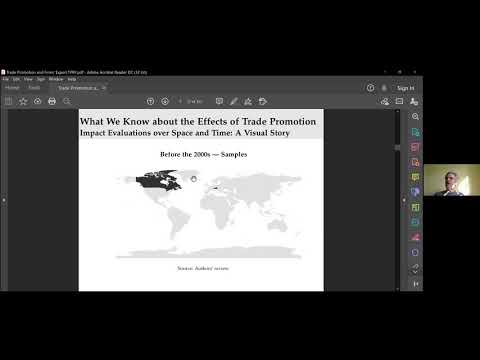 ▶
2021-04
Christian Volpe Martincus reviews evidence that information-focused export promotion helps firms, then examines benefits reaching domestic suppliers in Uruguay. Andrea Lassmann connects the findings to inclusive growth and regional policy. The discussion stresses program coordination, firm readiness, and unresolved identification and data limitations.
Read brief & watch →